✦ The Complete Rockstar Universe ✦
L.A. Noire
📅 Last updated:
Your guide to every Grand Theft Auto and Red Dead game, with tips, cheat codes, rankings and the best deals. Pick a game, dive in.
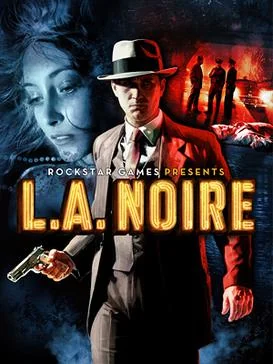
L.A. Noire is Rockstar's 2011 detective game, set in a carefully rebuilt 1947 Los Angeles.
You play Cole Phelps, a returning war veteran rising through the LAPD, and the core of the game is not shooting but interrogation: you gather evidence at a crime scene, then decide whether a witness is telling the truth, holding back or lying outright.
Every suspect was recorded with a facial capture technology built for the game, so a flicker of the eyes or a tightened jaw is a real performance rather than an animation. You question them line by line and judge each answer. Guess right and the case opens up. Guess wrong and you lose a lead, but the case continues rather than ending, which keeps the story moving.
The map reconstructs eight square miles of 1947 Los Angeles using period aerial photography and survey maps, right down to individual buildings. It is a driving city rather than a playground: you cross it between crime scenes, with a partner filling the silence, and that pace is deliberate.
Several cases are built on genuine 1940s Los Angeles crimes, including one arc that leans heavily on the Black Dahlia murder. The game moves you through Traffic, Homicide, Vice and Arson desks, and the tone darkens with each promotion.
L.A. Noire launched in 2011 and was remastered in 2017 for PlayStation 4, Xbox One and Nintendo Switch, with a separate VR version for PC. The remaster is the easiest way in and runs at a higher resolution with improved lighting. For what each version costs today, including the VR edition, see where to buy L.A. Noire.
Yes, but a restrained one. You can drive freely across 1947 Los Angeles and answer street crime calls, though the game is structured around cases rather than free roaming.
It was developed by Team Bondi and published by Rockstar Games, with Rockstar heavily involved in finishing the project. The studio closed shortly after release.
No sequel has been announced. A virtual reality spin-off, L.A. Noire: The VR Case Files, came out in 2017, but the main story has never been continued.